Posted on Leave a comment

Here Be Dragons: Vega Victrix 3, by Emmet A. O’Brien

Once again, this is a work by a close friend, who provided me with the review copy.

I like middle books best, and one of the things I like best in middle books is ramifications. You’ve had the chance to set up both world and characters, you have some idea what parameters the particular series is working under: how does Corin Oshima react to aliens? What is her idea of honor? What kind of goals does she find satisfying? We know all that now, we’ve had it established, so now’s the time to double down on matter anomalies, first contacts, and oh yes, solving a murder.

The Ralkhuri are here, Corin still has a fraught but duty-laden working relationship with the person who betrayed her most deeply before the series ever started, and we’re definitely poking into the deeper layers of meaning of life, the universe, and everything. And this time the answer is much more complicated than 42. Don’t start here, start with the first book, it’s very much in print–but definitely keep going, there’s a lot here to love.

Posted on Leave a comment

SciFi Reading Hour!

This September is absolutely jam-packed with premium Marissa content, friends. If you’re local to the Twin Cities area, come on out on September 10 for the SciFi Reading Hour at the Bryant Lake Bowl! The BLB is a Twin Cities institution, with restaurant, bowling alley, and theater area, and I’ll be performing with musician Martin Law and sharing the bill with organizer and fellow SFF writer Cole Sarar. Tickets are $15 in advance, $18 at the door! And this is just the beginning….

Posted on Leave a comment

Books read, early August

Natalie Adler, Waiting on a Friend. You find this out in chapter one, it is not a spoiler: this is the story of a young lesbian in NYC in the 1980s who can see ghosts, who can see all her friends who have died of AIDS except for her best friend. When I told the young people in my life this premise they literally gasped, and they were correct to do so. It’s beautifully done, but if you think “that sounds like it would rip my heart out and repeatedly smash it with a hammer,” well, yes, you’re not wrong about that. I was up for that, and I recommend it, but no shade if you need to wait for a better day for it.

Danielle Allen, Radical Duke: How One Aristocrat–and the American Revolution–Transformed Britain. Not a particularly well-written book, but with material I wanted to know, which is in some ways the worst kind of nonfiction. Still, if you want to know about the radical politics of the Duke of Richmond and his political relationship with Thomas Paine, here’s where you can find that.

Robert Jackson Bennett, A Trade of Blood. The most recent of the Ana and Din books. I think my favorite of them so far. I like where this went and where it seems to be going. Hooray.

Agatha Christie, Five Little Pigs, Lord Edgware Dies, Sad Cypress, Sparkling Cyanide, The Hollow, The Labors of Hercules, and The Sittaford Mystery. Kindle. Look what the library’s digital collection got in from my holds list in time for me to travel. Yep, these sure are by Agatha Christie. The Labors of Hercules is a short story collection, and I continue to find mystery shorts unsatisfying; ah well.

Madelaine Drohan, He Did Not Conquer: Ben Franklin’s Failure to Annex Canada. Too much boyfriend, not enough roller derby. Ope, sorry, that is: too much Ben Franklin, not enough Canada. You can read about Ben Franklin all sorts of other places and not nearly enough about the inter-British-colony politics of the 1770s. Ah well, it’s a start at least.

Safia Elhillo, The January Children. For me this is an example of it being a good idea to read poets who don’t immediately resonate, who are coming from a different place than oneself completely. Interesting poems rather than ones that speak directly to my heart, but that’s good, I shouldn’t be the target audience for everything, and I’m not.

Barbara Hambly, Death in the Palace. Latest in her 1920s Hollywood series. If you like these, this sure is another one, and I do, so here we are.

Heide Island, Romp! A Journey Through the Natural History of Otters and Why They Matter. Delightful natural history of otters, with lots of detail about field study of them. This kind of natural history is good for my spirits, might be good for yours too.

Michael Karns, Dennis Becker, and Lisa Golden Schroeder, Untamed Mushrooms: From Field to Table (A Midwestern Guide). Things you can do with foraged mushrooms. I like foraged mushrooms. I’d thought of several of these things more or less, but not all.

T. Kingfisher, Nine Goblins and The Raven and the Reindeer. Both very short older works, very different tonally. The latter is a Snow Queen retelling, which I often like and did like in this case; the former is goblin-perspective, which I often don’t like but did this time. Like Ursula (that is, Kingfisher), I read and watched a great deal of All Creatures Great and Small as a tiny kid, so the fantasy vet helping the unicorn give birth and so on was exactly up my alley.

Just Knut Qvigstad and Isak Saba, Sámi Folktales from the Near and Far Worlds. An old compendium of folk tales, most of them with magical content, in a new translation. Beautiful, easy to read, fascinating perspective, especially because these are not retellings that are polished to fit particular molds or have palatable contemporary morals. Really good resource.

David Woodman, The First King of England: Aethelstan and the Birth of a Kingdom. When you read a lot of books about a particular topic, you start to pick out which one is for which strengths, and the major strength of this one over other books about Aethelstan is that it spends time on the Welsh and how they fit into the whole picture.

Posted on 2 Comments

Made glorious summer by this….

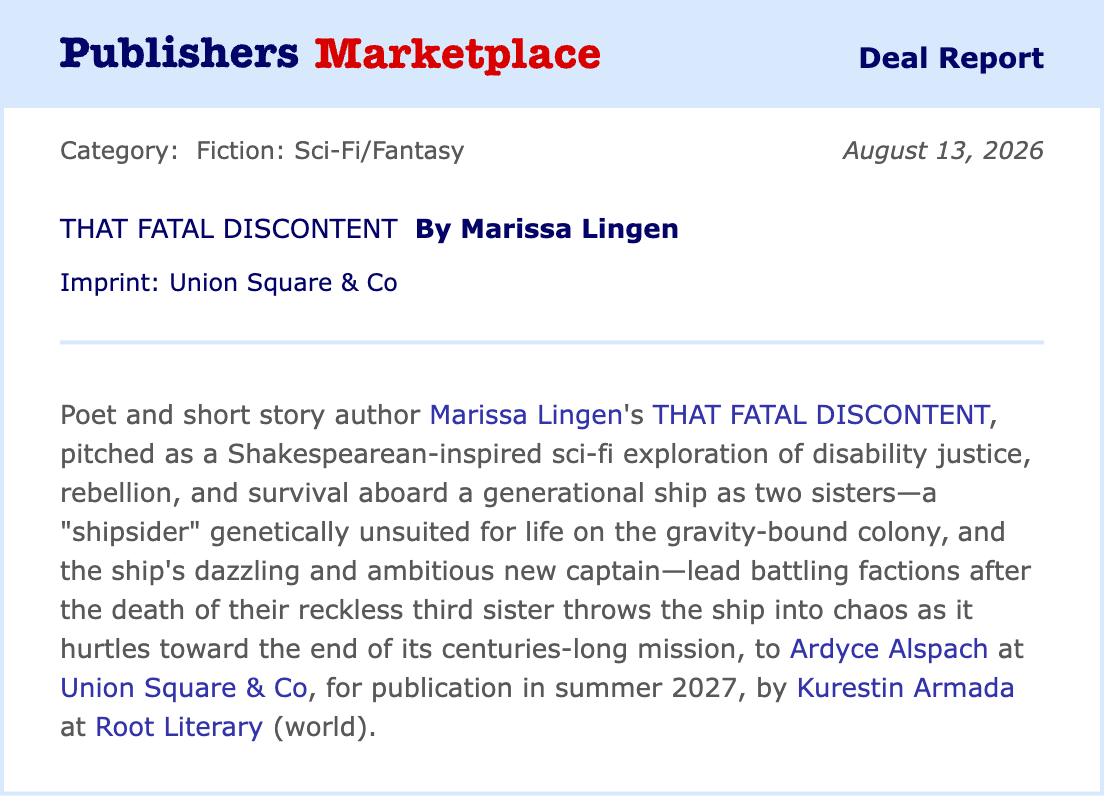
I’m in Michigan visiting M’s family when what should show up in my inbox? OH HI:

What’s this? Why it’s the Publishers Marketplace announcement of next year’s book! I’m doing edits on That Fatal Discontent now, to bring it to the world next summer! Something else to look forward to!

Since I’m traveling, I’m in an unfamiliar format that is not making it clear whether there’s alt-text, so in case you can’t read the image, it’s all text, and it says, “PUBLISHERS MARKETPLACE Deal Report. Category: Sci-Fi and Fantasy. August 13, 2026. THAT FATAL DISCONTENT by Marissa Lingen. Imprint: Union Square & Co. Poet and short story author Marissa Lingen’s THAT FATAL DISCONTENT, pitched as a Shakespearean-inspired sci-fi exploration of disability justice, rebellion, and survival aboard a generation ship as two sisters–a ‘shipsider’ genetically unsuited for life on the gravity-bound colony, and the ship’s dazzling and ambitious new captain–lead battling factions after the death of their reckless third sister throws the ship into chaos as it hurtles toward the end of its centuries-long mission, to Ardyce Alspach at Union Square & Co, for publication in summer 2027, by Kurestin Armada at Root Literary (world).”

Posted on Leave a comment

Ghost story with tomato soup

New story out in Strange Horizons today! Scarcely Gone is a thing I haven’t done much of: it’s a ghost story. In this case it’s a ghost story with a John Denver title: “he’d rather play his banjo in the morning when the moon is scarcely gone” from “I Guess He’d Rather Be in Colorado.” That makes this one of a random series of stories I’ve written from fragments of my dad’s music, which are not linked in any other way except that their titles came from singing artists Dad loved around the house.

(This is why, incidentally, “the story behind the story” is often so hard to write: because “how did you come to write this story?” often has a beginning like “well, when I was preverbal my parents listened to a bunch of James Taylor, so….”)

Anyway, hope you enjoy my foray into the world of ghost stories!

Posted on Leave a comment

Books read, late July

Melissa Albert, The Children. I found this very readable at the sentence, paragraph, and chapter level. When I put it down, I very much wanted to go pick it up again; it was the sort of book I wanted to be reading. Part of this is that Albert is good at the mechanics of writing, and part of it is “something mysterious and probably magical [but not necessarily] is going on with the family of a children’s book writer” is really my jam. As I got further into the book and the protagonist processed more about her childhood, I started thinking that what I would say about this is that it’s an interesting example of a book that works despite the protagonist being very reactive and having almost no agency for most of the book, at times seeming to flee from agency. Then I got to the ending, and that’s not what I’m saying here after all, because I don’t think it works after all, and I think the protagonist’s avoidance is a large part of why, all the way through to the end. I didn’t even feel like her agency had been taken, so I couldn’t make it work in that direction, just: welp. No thank you. Sigh.

Agatha Christie, Mrs. McGinty’s Dead. Kindle. On the quirky end of Christie’s mysteries, which for me is nice.

Jennifer Graham, The Fall of Iris Henley. A teen thriller about a girl who’s anonymously accused of murder and finds very little support from the people she once trusted. A very tense read, unfortunately all too real in its social dynamics.

Christopher Gravett, Towton 1461: England’s Bloodiest Battle. A friend picked this up, I don’t know whether it was at Towton or somewhere related, but this is definitely the kind of lots-of-pictures battlefield history they sell at battlefields and related museums. Lots of detailed maps from different points in the day. Useful if you’re interested in this specific topic, which I am, it’s adjacent to my Ricardian needs.

Scott S. Greenberger, The Unexpected President: The Life and Times of Chester A. Arthur. I would love to say that Chester A. Arthur was more interesting than you’d think, but truly, he’s not. Now we know, I guess. I don’t even blame Greenberger. Just: yah, nobody wanted this guy to be president including himself, and he was, and then he died.

Inhabit Education Books, The Life & Art of Germaine Arnattaujuq. This title came up when I was searching (fruitlessly) for some other Arctic art topic in my library’s card catalog. It is very much a children’s book, the sort of simple summary of a complex career that I didn’t really like even when I was its target age. But the bits of her work visible in it were cool.

Kim Choyeop, If We Cannot Go at the Speed of Light. I feel like we’re getting a wider range of East Asian SFF translated into English than we were a decade ago, and I feel like particularly Korean SFF is now allowed to be human-focused and “soft” in ways that 1) I love and 2) were not considered translation-worthy in the not-too-distant past. So when there’s a very human-focused short story collection like this one, I feel very lucky indeed. Recommended.

E.C.R. Lorac, Crock o’Lune. Kindle. A not particularly quirky regional mystery, reasonably well done as the other Loracs generally have been.

Sarah M.S. Pearsall, Freedom Round the Globe: A World History of the American Revolution. Lots of books about the American Revolution this year for obvious reasons, and I appreciate that this one treated both the lead-up and the fallout as parts of global phenomena contributed to by many people and many types of people. Interesting stuff, in some ways wish it had been longer (but it’s not a super-short book already!).

Andrew Pettegree and Arthur der Weduwen, The Bookshop of the World: Making and Trading Books in the Dutch Golden Age. So much about printing and selling books! So much! So much attention to printing ephemera! This is for the dedicated nerd, but if you are one, here it is.

Maya C. Popa, Wound Is the Origin of Wonder. The kind of poetry collection that takes language musings and runs with them at poetic length, which is nearly always of interest to me. The titular poem and related ones thread through in a very good way.

Mykaela Saunders, ed., This All Come Back Now: An Anthology of First Nations Speculative Fiction. This is a book club book, and the “First Nations” in the title refers to Australian First Nations only. I can’t say it’s one of our more successful selections, I think partly because it has several excerpts and we, on average as a group, really don’t like excerpts. (I personally do not like excerpts! I am part of bringing the average well into the negative on this point!) I think the other thing that was difficult about this anthology is that none of us had the experience to be able to sort out editorial bias from general cultural viewpoint. So…now we’ll all have this when we read more Australian First Nations SFF, and that’s a good thing? But it didn’t make the experience of reading and discussing this volume as satisfying as some others.

Nghi Vo, The Scarlet Ball. Discussed elsewhere.

Jesse Wegman, The Lost Founder: James Wilson and the Forgotten Fight for a People’s Constitution. Wilson was an absolute personal disaster, and Wegman never gets so entranced with his subject that he loses sight of that. (To be fair, Wilson would make it very hard to lose sight of that.) He pointed out a lot of the things many of us see as problems now in the US Constitution! He fought for it to be better than it eventually was! Also he had absolutely no financial skills and considered running and hiding to be a great approach to problems, so. Yeah.

G. Willow Wilson and M.K. Perker, The Stoneshore Register. This is the sort of graphic novel that I can see would better suit people who are far more visual than I am. Its art is lovely, its text goes beautifully with the art, and there just isn’t enough story there for me to find it particularly satisfying.

John Wiswell, The Dragon Has Some Complaints. I really really hope this book finds its audience, because it’s warm and funny and also extremely honest about physical and emotional trauma recovery, and frankly when I’ve had physical and emotional trauma recovery, things that were both honest and funny were extremely hard to come by. Especially things with dragons! Especially things with dragons and political machinations! I love those things! I love this book! Read this book.

Francis Young, Silence of the Gods: The Untold History of Europe’s Last Pagan Peoples. I really like that this book is primarily organized temporally but also has geographic sub-organization after that, because it reflects how much Young is not assuming that the beliefs of, say, the Saami and the Estonians had to be at all similar to be dealt with in a similar analysis and time frame. He’s very careful about the places where he can talk about the people but not about the details of their beliefs, and that’s fascinating too. I’m very interested in this topic, but I think that even people who are less keen on it might find a lot that would be of interest here.